
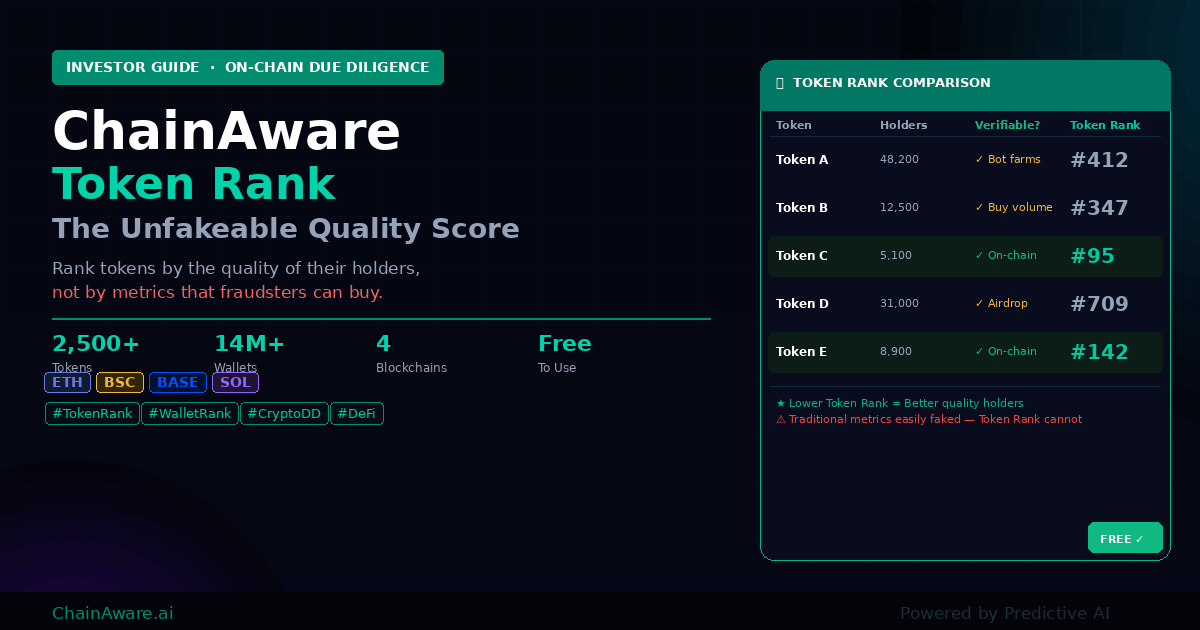
Every cycle, the same story plays out. A token launches with impressive numbers: 50,000 holders, $10 million in daily volume, 100,000 Twitter followers, 50,000 CoinGecko watchlist adds, glowing KOL endorsements. Investors pile in. Price pumps. And then – steadily or suddenly – it collapses, leaving retail buyers holding bags while the original holders have long since exited.
The metrics were real. The numbers were accurate. But the metrics were wrong – not because they were falsified, but because they were easily falsified, and sophisticated players knew it.
ChainAware Token Rank exists because the metrics investors rely on most are the ones fraudsters find cheapest to manufacture. It is a fundamentally different approach to token evaluation: instead of measuring how many wallets hold a token, Token Rank measures the quality of those wallets – using the same behavioral intelligence that powers ChainAware.ai’s full Wallet Auditor. A quick reference to Token Rank methodology and use cases is available at the Token Rank learn guide.
This guide explains how Token Rank works, why it resists manipulation where other metrics fail, what it reveals about any token’s holder community, and how to use it as the cornerstone of your on-chain due diligence workflow.
The Problem: Cheap Fakes, Expensive Mistakes
Here is the current market rate for the metrics that most crypto investors use to evaluate a token:
- Holder count inflation: Creating thousands of fresh wallet addresses and sending dust amounts costs a few hundred dollars in gas and a few hours of scripting.
- Trading volume wash trading: A single actor controlling two wallets and trading between them generates real on-chain volume at the cost of gas fees.
- Twitter followers and engagement: Follower farms and engagement pods are available for as little as $50 per 1,000 followers.
- CoinGecko and CoinMarketCap watchlist adds: Both platforms have well-documented histories of metric manipulation.
- KOL endorsements: Pay-for-promotion has become standard practice. The promotion appears organic to followers who trust them.
The result is an information environment where the signals investors use most are precisely the signals that bad actors manipulate most aggressively. According to Chainalysis’s 2024 crypto crime report, market manipulation and fraudulent token schemes continue to represent one of the largest categories of crypto financial losses globally.
Token Rank cuts through this by going to the one source of information that cannot be cheaply faked: on-chain behavioral history.
Free – No Signup Required
Check Any Token’s Holder Quality Before You Buy
Token Rank shows you the real quality of any token’s holder base – based on on-chain truth, not metrics that can be bought for $50. Free for any AI, RWA, DeFi, or DeFAI token on Ethereum, BSC, Base, or Solana.
How Token Rank Works: From Wallet Rank to Token Rank
Token Rank is built on a foundation of individual wallet intelligence. The methodology is transparent and reproducible:
- Identify all holders – ChainAware.ai identifies every wallet currently holding a meaningful position in the token on supported chains.
- Apply the holding threshold filter – Only holders with a position above the median holding size are counted. This critical filter means that dust airdrops to thousands of low-quality wallets cannot inflate Token Rank.
- Run a full Wallet Audit on every qualifying holder – Each wallet receives a complete behavioral profile via the Wallet Auditor: risk willingness, experience, risk capability, predicted trust, intentions, transaction categories, protocol diversity, AML status, wallet age, and wallet balance. From these ten parameters, a Wallet Rank is calculated. Full Wallet Auditor documentation at the Wallet Auditor learn guide.
- Compute the median Wallet Rank – All holder Wallet Ranks are collected into an array. The median of this array becomes the Token Rank.
- Lower median = better Token Rank – Since lower Wallet Rank numbers represent higher quality wallets (rank #200 is better than rank #20,000), a lower median Wallet Rank across holders means a higher-quality holder community – and a better Token Rank.
For a deep understanding of how individual Wallet Rank is calculated, see our complete guide to ChainAware Wallet Rank.
Why Token Rank Is Extremely Difficult to Fake
The claim is not that Token Rank is impossible to manipulate – it’s that manipulation is prohibitively expensive compared to every other crypto metric.
To get a good Wallet Rank, a wallet needs genuinely: years of on-chain history, diverse protocol usage across multiple categories, human-cadence transaction timing, clean AML history, meaningful balance, and broad protocol footprint. These qualities take time and sustained activity to build. They cannot be scripted quickly.
To move Token Rank meaningfully, an attacker would need to either: (a) create a large number of high-Wallet-Rank wallets – which requires years of convincing on-chain behavior per wallet – or (b) acquire a large number of existing high-Wallet-Rank wallets at significant cost. Either path is extraordinarily expensive. Compare this to inflating holder count (create fresh wallets, send dust – costs pennies per wallet). The asymmetry is stark.
According to McKinsey research on fraud economics, the cost-benefit calculus of manipulation collapses when the cost of manufacturing false signals approaches or exceeds the expected gain.
What Token Rank Reveals: 6 Holder Patterns and What They Mean
Beyond the single Token Rank number, the underlying wallet distribution data tells detailed stories about a token’s holder community. Here are the six most instructive patterns.
Pattern 1: Airdrop to New Wallets → Token Rank Collapses
New wallets have very low Wallet Ranks – they have no history, no protocol experience, no age. When these wallets become token holders, they drag down the median Wallet Rank. When you see a token with many holders but a poor Token Rank, the first question is: were those holders acquired via airdrop to low-quality wallets?
Pattern 2: Targeted Airdrop to High-Wallet-Rank Addresses → Token Rank Improves
Selectively airdropping to wallets with good Wallet Ranks does improve Token Rank – but only when those wallets receive a meaningful position (above the median holding threshold). A project that chose experienced DeFi participants as its genesis holder base has made a fundamentally different decision about the community it wants to build.
Pattern 3: Holders with Experience Level 1 or New Wallets → Tokens Dumped to Newcomers
When the majority of a token’s qualifying holders have very low Experience scores, it signals the token has found its way primarily into the hands of Web3 newcomers – the most vulnerable participants in the ecosystem. A token whose holder base is dominated by newcomers is a token that experienced participants have already exited.
Pattern 4: Holders with Low Risk Willingness → Community Will Sell at the First Challenge
Risk Willingness measures how psychologically ready a wallet’s owner is to sustain positions through volatility. When a token’s holder base shows low median Risk Willingness, the community is likely to sell at the first significant price challenge. Conversely, holders with high Risk Willingness have demonstrated they can hold through volatility.
Pattern 5: Concentrated High-Quality Holders → Conviction Community with Centralization Risk
A token with an excellent Token Rank but high concentration in a small number of high-Wallet-Rank wallets offers strong community quality but meaningful centralization risk. A large-holder exit could disproportionately impact price.
Pattern 6: Improving Token Rank Over Time → Organic Quality Accumulation
A token whose Token Rank has been steadily improving over months is attracting progressively higher-quality holders. This is the pattern of organic, genuine adoption – often visible in Token Rank data well before it shows up in price action or social metrics. According to Harvard Business Review’s research on behavioral prediction, behavioral data consistently leads lagging indicators like price and social engagement in signaling genuine adoption.
Due Diligence Before You Buy
Which Pattern Does Your Target Token Show?
Check any AI, RWA, DeFi, or DeFAI token’s holder quality distribution on Ethereum, BSC, Base, or Solana. Free, instant, no account required. 2,500+ tokens already calculated.
Supported Token Categories and Chains
ChainAware Token Rank currently covers four token categories: AI Tokens, RWA Tokens, DeFi Tokens, and DeFAI Tokens. Supported chains: Ethereum, BNB Smart Chain, Base, Solana. Tokens calculated: 2,500+ and growing. All wallet calculations are performed via the Wallet Audit API and are part of ChainAware.ai’s Web3 Predictive Data Layer – the same 14M+ wallet database that underlies every ChainAware product.
How to Use Token Rank (Step by Step)
Token Rank is free to use, requires no account, and is accessible at chainaware.ai/token-rank.
Step 1: Search for the token by name, ticker, or contract address. Step 2: Read the overall Token Rank – the position within its category (lower = better). Step 3: Examine the holder distribution breakdown by Wallet Rank quality tier. Step 4: Check Experience Level distribution – majority experienced DeFi participants (Level 4-5) or newcomers (Level 1-2)? Step 5: Review Risk Willingness of holders to set expectations for price stability. Step 6: Audit specific large holders via the free Wallet Auditor for more granular insight. Step 7: Track Token Rank over time to observe improving or deteriorating holder quality composition.
Real-World Use Cases
Pre-Investment Due Diligence
Before entering any position in an unfamiliar token, checking Token Rank takes two minutes and provides information that is simply not available from any other free source. Combine Token Rank with standard due diligence – tokenomics review, team background check, smart contract audit status – for a more complete picture than volume and social metrics alone can provide.
Red Flag Detection: The Manipulation Screen
The most powerful use case: high conventional metrics (holder count, volume, social engagement) combined with poor Token Rank is a strong signal that conventional metrics have been manufactured while the on-chain holder quality data tells a different, unflattering truth.
Competitive Token Analysis Within a Category
Token Rank enables direct comparison between tokens in the same category. Two AI tokens with similar market caps and social metrics may have dramatically different Token Ranks – meaning one has attracted experienced AI + Web3 participants while the other has primarily found its way into newcomer wallets.
Protocol Listing and Integration Decisions
DeFi protocols evaluating which tokens to support for trading pairs, lending markets, or yield vaults face specific risk. Token Rank provides an objective, quantitative holder quality signal that complements technical security audits and liquidity assessments. Full analytics infrastructure for DeFi listing decisions at the DeFi Business Analytics learn guide. According to Gartner’s research on data-driven decision making, organizations that incorporate behavioral data into decision processes systematically outperform those relying on lagging or manipulable indicators.
DAO and Governance Quality Assessment
Token Rank’s holder experience and behavioral data provides a complementary lens for assessing governance quality. A DAO whose token holders are predominantly experienced, long-term DeFi participants is likely to make better governance decisions than one dominated by short-term speculative holders.
Early Signal for Emerging Projects
When a new or lesser-known token shows an improving Token Rank – its holder base quality increasing over time as experienced participants accumulate – this can be an early signal that sophisticated money is paying attention, often well before any price movement or social media coverage reflects it.
Start Your On-Chain Due Diligence
Check the Token You’re Researching Right Now
2,500+ tokens ranked across AI, RWA, DeFi, and DeFAI categories on Ethereum, BSC, Base, and Solana. Free, no account required. Takes 60 seconds.
Token Rank in the ChainAware Ecosystem
Token Rank is one product in a connected suite of Web3 behavioral intelligence tools, all built on ChainAware.ai’s Web3 Predictive Data Layer covering 14M+ wallets. Understanding how the tools connect helps you build a complete due diligence workflow.
Wallet Auditor → Individual Wallet Intelligence
The free Wallet Auditor gives you the full behavioral profile for any single wallet: all ten Wallet Rank parameters, AML status, predicted trust score (98% accuracy), intentions, protocol history, and the Wallet Rank itself. Use it to audit specific large holders of any token you’re researching, to verify the on-chain credentials of business partners or KOLs, or to check your own wallet’s profile. Full documentation at the Wallet Auditor learn guide.
Wallet Rank → The Foundation of Everything
Wallet Rank is the single consolidated reputation score derived from all ten Wallet Audit parameters. It is the atomic unit that Token Rank aggregates. Full guide: ChainAware Wallet Rank: The Complete Guide.
Predictive Fraud Detector → AML and Fraud Deep Dive
For any wallet where the Wallet Auditor’s Predicted Trust score raises concerns, the free Predictive Fraud Detector provides forensic-level AML and fraud analysis across 7 chains. Full fraud detection methodology at the Security & Fraud Agents learn guide.
Behavioral Prediction MCP → Platform Integration
For developers building investment tools, portfolio analytics, or DeFi platforms, the Behavioral Prediction MCP exposes Wallet Rank, Wallet Audit, and Token Rank data via a real-time API endpoint. Full documentation at the Prediction MCP learn guide. Integrate holder quality analysis directly into your platform without engineering complexity.
Web3 Behavioral Analytics → Your Platform’s User Base
For platforms and protocols that want to understand the behavioral quality of their own users in aggregate, Web3 Behavioral Analytics provides the aggregate picture: the distribution of risk willingness, experience levels, intentions, and Wallet Ranks across your entire Dapp user base. See how SmartCredit.io used this data to achieve 8x engagement and 2x conversions.
Frequently Asked Questions
Is Token Rank really free?
Yes – Token Rank at chainaware.ai/token-rank is completely free for individual research use. No account, no payment, no rate limits for normal research use.
Why does the holding threshold filter matter?
Without the threshold filter, a project could deposit tiny amounts of tokens into millions of fresh wallets and devastate Token Rank. The threshold filter – counting only holders above the median position size – means that dust airdrops to low-quality wallets have zero impact on Token Rank. Only meaningful holders count.
Can a project improve its Token Rank legitimately?
Yes – by genuinely attracting high-quality holders. This means building a product that experienced DeFi participants find valuable enough to hold a meaningful position in. Projects that achieve this through product quality, genuine community building, and transparent communication naturally attract better Wallet Rank holders over time, improving Token Rank organically.
How often is Token Rank updated?
Token Rank is recalculated on a regular basis as holder composition changes. For actively traded tokens with frequent holder turnover, this means Token Rank reflects relatively current holder quality rather than a stale historical snapshot.
What if my token isn’t listed yet?
Coverage is expanding continuously – currently 2,500+ tokens across AI, RWA, DeFi, and DeFAI categories on Ethereum, BSC, Base, and Solana. Contact ChainAware.ai to request coverage for a specific token.
How does Token Rank relate to token price?
Token Rank is not a price prediction tool. It measures holder quality, which is a leading indicator of community stability and organic demand – but many other factors determine price. Use Token Rank as one input in your due diligence process alongside fundamentals, liquidity analysis, and your own judgment.
ChainAware.ai – On-Chain Truth for Smarter Decisions
Stop Trusting Metrics That Cost $50 to Fake
Token Rank, Wallet Rank, AML analysis, and fraud prediction – all built on on-chain behavioral data that cannot be cheaply manufactured. Free tools, no account required, instant results.